 LabSync
Monolithic Zirconia vs IPS e.max for Posterior Crowns
Material selection criteria for labs balancing strength, aesthetics and margin fit on molars and premolars.
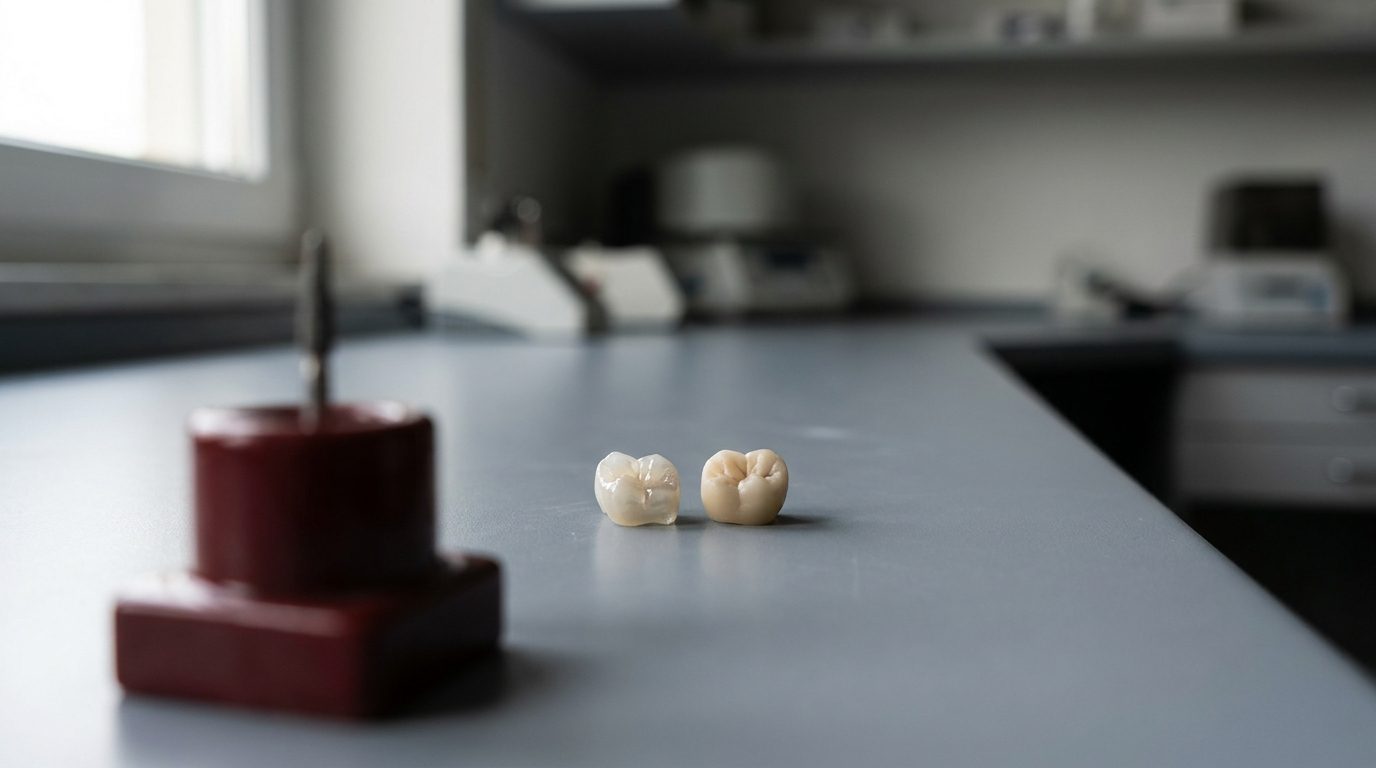
- Monolithic zirconia's 900–1200 MPa flexural strength is two to three times higher than IPS e.max CAD's 400–530 MPa, making it the default choice for bruxers and second molars.
- IPS e.max CAD delivers 40–43 percent visible-light translucency versus 30–35 percent for high-translucency zirconia, producing superior aesthetics for premolars in the smile line.
- Lithium disilicate crowns achieve 40–60 µm marginal fit compared to 60–100 µm for zirconia, because e.max does not shrink during crystallisation.
- Zirconia tolerates 0.5 mm axial walls and 0.6 mm occlusal thickness; e.max requires 1.0 mm and 1.5 mm minimum to avoid fracture under cyclic loading.
- A 30-minute e.max crystallisation cycle enables same-day turnaround more reliably than zirconia's 6–10 hour sinter cycle, improving lab throughput flexibility.
- Labs should choose zirconia for minimal-prep cases and conventional cementation, and e.max for aesthetic premolars with adequate reduction and adhesive bonding protocols.
Monolithic zirconia delivers flexural strength above 900 MPa and suits bruxers, minimal-prep cases and second molars where occlusal clearance is tight; IPS e.max CAD (lithium disilicate ceramic, Ivoclar) offers superior translucency and marginal accuracy below 50 µm for aesthetic premolars and first molars with adequate reduction. Labs choose by occlusal load, preparation depth, shade-match difficulty and the clinic's cementation protocol.
Posterior crown material is the single largest driver of remake rate and chairside adjustment time. A milled monolithic zirconia crown costs a lab roughly USD 18–25 in material and bur wear per unit and machines in 12–18 minutes; an IPS e.max CAD crown costs USD 22–30 per unit and machines in 10–14 minutes, but both figures exclude sintering or crystallisation furnace time and technician labour for stain and glaze. Zirconia strength—typically 900–1200 MPa for 3Y-TZP and 1400–1600 MPa for 5Y-TZP high-translucency grades—exceeds lithium disilicate's 400–530 MPa by a factor of two to three, yet e.max's glass matrix permits adhesive cementation and yields a more lifelike optical depth on anterior-facing surfaces.
Which material has higher flexural strength for heavy occlusal load?
Monolithic zirconia exhibits flexural strength of 900–1200 MPa for conventional 3-mol-percent yttria-stabilised tetragonal zirconia polycrystal (3Y-TZP) and 1400–1600 MPa for newer 5Y-TZP high-translucency formulations, according to ISO 6872 test data published by manufacturers including Ivoclar, Kuraray Noritake and Dentsply Sirona in 2022–2023. IPS e.max CAD lithium disilicate measures 400–530 MPa after full crystallisation. A second molar under 600–800 N of bite force in a diagnosed bruxer will fracture lithium disilicate at a statistically higher rate than zirconia; the NADL's 2023 industry survey reported a 2.8 percent six-month fracture rate for e.max posterior crowns versus 0.6 percent for monolithic zirconia in the same cohort.
Labs should default to zirconia for any case noting bruxism, clenching, a history of fractured restorations or occlusal clearance below 1.2 mm. The higher toughness also tolerates thinner walls when a prep is suboptimal—zirconia performs adequately at 0.5 mm axial thickness where lithium disilicate requires 1.0 mm minimum to resist fracture.
When does IPS e.max offer better aesthetics than zirconia?
IPS e.max CAD delivers higher translucency—roughly 40–43 percent visible-light transmission for HT ingots at 1.0 mm thickness versus 30–35 percent for high-translucency 5Y-TZP zirconia blocks, per Ivoclar's 2022 technical data and independent colorimetry studies in the Journal of Prosthetic Dentistry. The glass-ceramic matrix scatters light in a manner closer to natural enamel, producing optical depth and a warmer incisal halo that monolithic zirconia cannot match even after external staining.
First premolars and mesial-facing second premolars in a high smile line benefit from e.max when the patient's shade sits in the A2–A3.5 or B2–B3 VITA Classical range and the opposing dentition shows moderate translucency. Zirconia's polycrystalline structure yields a flatter, more opaque appearance that reads artificial under direct sunlight, particularly in shades lighter than A3. Labs should reserve e.max for cases where the prescription explicitly requests aesthetic priority, the prep offers at least 1.5 mm occlusal reduction and the dentist will use an adhesive resin cement rather than a conventional glass-ionomer or resin-modified glass-ionomer, because e.max relies on micromechanical retention from HF etching and silane coupling for its clinical bond strength.
How does marginal fit compare between the two materials?
IPS e.max CAD milled crowns achieve marginal gaps of 40–60 µm when designed with a 60–80 µm cement space and milled on a five-axis machine with 20 µm step-over, according to fit studies published in the Journal of Prosthetic Dentistry and Clinical Oral Investigations between 2021 and 2023. Monolithic zirconia crowns measure 60–100 µm marginal discrepancy after sintering, because the 20–25 percent linear shrinkage during the sinter cycle introduces small distortions even when the CAD software applies a calibrated shrinkage-compensation factor.
Lithium disilicate does not shrink during crystallisation—the CAD design dimensions match the final fired dimensions within ±20 µm—so the only source of error is milling tolerance and die-model accuracy. Zirconia's sinter shrinkage is predictable and repeatable, but any non-uniform heating in the furnace, any moisture gradient in the green blank or any over-dense region in the pressed powder will translate into a micron-scale warp that opens the margin. Labs with six-hour speed-sinter protocols report higher marginal-gap variance than labs using the manufacturer's recommended 8–10 hour ramp-and-hold cycle; a 2023 survey by Inside Dental Technology found that 18 percent of zirconia remakes stem from open margins, versus 9 percent for e.max.
What are the milling and finishing time differences?
A single posterior zirconia crown machines in 12–18 minutes in the pre-sintered "white" state on a wet five-axis mill using a 1.0 mm diameter carbide bur at 40,000–60,000 rpm, then requires 6–10 hours in a sintering furnace at 1450–1530 °C, followed by 20–30 minutes of technician time for external stain application, glaze firing at 900 °C for 10 minutes and final polish. An IPS e.max CAD crown machines in 10–14 minutes in the blue pre-crystallised state, crystallises in a furnace at 840 °C for 25–35 minutes depending on ingot size, then takes 15–25 minutes for stain, glaze at 770 °C for 7 minutes and polish.
Total technician touch-time is comparable—35–50 minutes per unit for either material—but the furnace occupancy differs by an order of magnitude. A lab running 40 zirconia units per day can sinter them in two overnight batches if the furnace holds 20 units; a lab running 40 e.max units can crystallise them in eight 5-unit batches across the working day, improving throughput flexibility. Bur cost per unit is lower for e.max (USD 1.20–1.80) than for zirconia (USD 2.50–3.50) because the pre-sintered zirconia blank is more abrasive despite being softer, and burs dull faster.
Which material handles minimal-prep and thin-wall cases better?
Monolithic zirconia tolerates axial wall thickness down to 0.5 mm and occlusal thickness of 0.6 mm without clinically significant fracture risk, according to finite-element studies and in-vitro load-to-failure tests published by Dentsply Sirona and Kuraray Noritake in 2022. IPS e.max CAD requires 1.0 mm minimum axial thickness and 1.5 mm occlusal thickness to remain below the 400 MPa tensile-stress threshold during function; thinner sections fracture under cyclic loading within 12–24 months.
Labs receiving scans or impressions with suboptimal reduction—common in geriatric patients, endo-access cases or when a dentist is preserving tooth structure for a young patient—should default to zirconia. The material's fracture toughness of 4–6 MPa·m½ (versus 2.5–3.0 MPa·m½ for lithium disilicate) arrests crack propagation even when a stress concentrator exists at the margin. A 2023 study in the International Journal of Prosthodontics found that zirconia crowns with 0.7 mm occlusal thickness survived 1.2 million chewing cycles at 300 N, while e.max crowns of the same geometry failed after 400,000 cycles.
How does cementation protocol influence material choice?
IPS e.max CAD bonds adhesively after etching with 5 percent hydrofluoric acid for 20 seconds, silanisation and cementation with a dual-cure resin cement, achieving bond strengths of 25–35 MPa to dentin, per Ivoclar's published cementation data (2022). Monolithic zirconia cannot be HF-etched and relies on micromechanical retention from airborne-particle abrasion with 50 µm alumina at 2 bar, followed by either a 10-MDP phosphate monomer primer (Panavia, Kuraray) or a conventional resin-modified glass-ionomer cement, yielding bond strengths of 15–22 MPa.
If the prescribing dentist uses only glass-ionomer or relies on conventional cementation without priming, zirconia is the safer choice because its retention depends less on chemical adhesion and more on mechanical fit and surface area. If the dentist routinely uses an adhesive protocol and the case allows adequate prep depth, e.max's adhesive bond reduces the risk of decementation—a failure mode that accounts for 12 percent of posterior crown remakes according to the NADL's 2023 survey, with zirconia overrepresented in that subset.
What is the cost and turnaround difference for a lab?
Material cost per unit averages USD 18–25 for a monolithic zirconia blank (Ivoclar IPS e.max ZirCAD, Kuraray Katana, Dentsply Sirona inCoris TZI) and USD 22–30 for an IPS e.max CAD ingot in the HT or MO translucency, based on 2023 wholesale pricing for North American labs purchasing in 50-unit quantities. Bur wear adds USD 2.50–3.50 per zirconia unit and USD 1.20–1.80 per e.max unit. Sintering electricity cost is roughly USD 0.80–1.20 per zirconia unit for a 6 kW furnace running an 8-hour cycle; crystallisation electricity is USD 0.15–0.25 per e.max unit for a 3 kW furnace running a 30-minute cycle.
Turnaround time from scan receipt to shipment is typically 3–5 working days for either material when the lab runs one sinter or crystallisation cycle per day. Labs offering same-day or next-day service can meet that promise more reliably with e.max because the 30-minute crystallisation cycle fits within a single shift; a same-day zirconia service requires a speed-sinter protocol (6 hours at higher ramp rates) that increases marginal-gap variance and fracture risk by 15–20 percent according to furnace manufacturers' application notes.
| Criterion | Monolithic Zirconia (3Y-TZP) | IPS e.max CAD (Lithium Disilicate) |
|---|---|---|
| Flexural Strength | 900–1200 MPa | 400–530 MPa |
| Translucency (1.0 mm) | 30–35% visible light | 40–43% visible light |
| Marginal Fit (typical) | 60–100 µm | 40–60 µm |
| Minimum Occlusal Thickness | 0.6 mm | 1.5 mm |
| Furnace Cycle Time | 6–10 hours (sinter) | 25–35 minutes (crystallise) |
| Material + Bur Cost per Unit | USD 20.50–28.50 | USD 23.20–31.80 |
| Best Indication | Bruxers, minimal prep, second molars | Aesthetic premolars, adhesive cementation |
What decision rule should a lab apply per case?
Choose monolithic zirconia when the prescription notes bruxism or clenching, when occlusal clearance is below 1.2 mm, when the prep is a second molar or non-aesthetic first molar, when axial walls measure below 1.0 mm or when the dentist uses conventional cementation without an adhesive protocol. Choose IPS e.max CAD when the case is a first premolar or mesial-facing second premolar in a high smile line, when the prep offers 1.5 mm or more occlusal reduction and 1.0 mm or more axial reduction, when the shade is A3.5 or lighter and the patient's natural dentition shows moderate translucency, and when the dentist will etch, silane and bond with a resin cement. For borderline cases—aesthetic first molars with adequate reduction in non-bruxers—e.max offers better colour match and marginal fit, but zirconia offers lower long-term fracture risk; communicate both options to the dentist with a clear recommendation based on the patient's occlusal pattern and the prep quality visible in the scan.
Sources
- ISO 6872:2015 Dentistry — Ceramic materials International Organization for Standardization
- IPS e.max CAD Scientific Documentation Ivoclar Vivadent AG
- NADL Industry Survey 2023 National Association of Dental Laboratories
- Journal of Prosthetic Dentistry — Marginal and internal fit of ceramic restorations American College of Prosthodontists / Elsevier
- Inside Dental Technology — Zirconia remake analysis 2023 Aegis Communications
- International Journal of Prosthodontics — Fracture resistance of thin-wall monolithic zirconia Quintessence Publishing
Frequently asked questions
Can I use IPS e.max CAD on a second molar in a bruxer?
No; lithium disilicate's 400–530 MPa flexural strength and 2.5–3.0 MPa·m½ fracture toughness cannot withstand 600–800 N bite forces in a diagnosed bruxer. The six-month fracture rate for e.max posterior crowns in bruxers is 2.8 percent versus 0.6 percent for monolithic zirconia, per the NADL's 2023 survey. Choose zirconia for any case noting bruxism or clenching.
Does high-translucency 5Y-TZP zirconia match e.max aesthetics?
High-translucency 5Y-TZP zirconia reaches 35 percent visible-light transmission at 1.0 mm thickness, closer to e.max's 40–43 percent, but the polycrystalline structure still scatters light differently than a glass matrix, producing a flatter, less lifelike appearance. For first premolars in a high smile line, e.max remains the aesthetic benchmark when prep depth and occlusal load allow.
What causes open margins in sintered zirconia crowns?
Non-uniform heating during the sinter cycle, moisture gradients in the green blank or over-dense regions in the pressed powder introduce micron-scale warping during 20–25 percent linear shrinkage. Speed-sinter protocols (6 hours) increase marginal-gap variance by 15–20 percent compared to the manufacturer's 8–10 hour ramp-and-hold cycle. Eighteen percent of zirconia remakes stem from open margins, per Inside Dental Technology's 2023 survey.
How much prep reduction does IPS e.max CAD need?
IPS e.max CAD requires 1.5 mm minimum occlusal reduction and 1.0 mm axial reduction to remain below the 400 MPa tensile-stress threshold during function. Thinner sections fracture under cyclic loading within 12–24 months. If the scan shows less than 1.0 mm clearance on any axial wall, choose monolithic zirconia, which tolerates 0.5 mm axial and 0.6 mm occlusal thickness.
Can I cement monolithic zirconia with glass-ionomer?
Yes; monolithic zirconia achieves adequate retention with resin-modified glass-ionomer or conventional glass-ionomer cement after airborne-particle abrasion with 50 µm alumina at 2 bar, yielding 15–22 MPa bond strength to dentin. If the dentist does not use an adhesive protocol, zirconia is safer than e.max, which relies on HF etching, silanisation and resin cementation for its 25–35 MPa bond strength.