LabSync
Dental Lab Pricing: How to Build a Defensible Price List
Calculate true cost per case, apply margin rules and structure a price list that covers overhead while staying competitive.
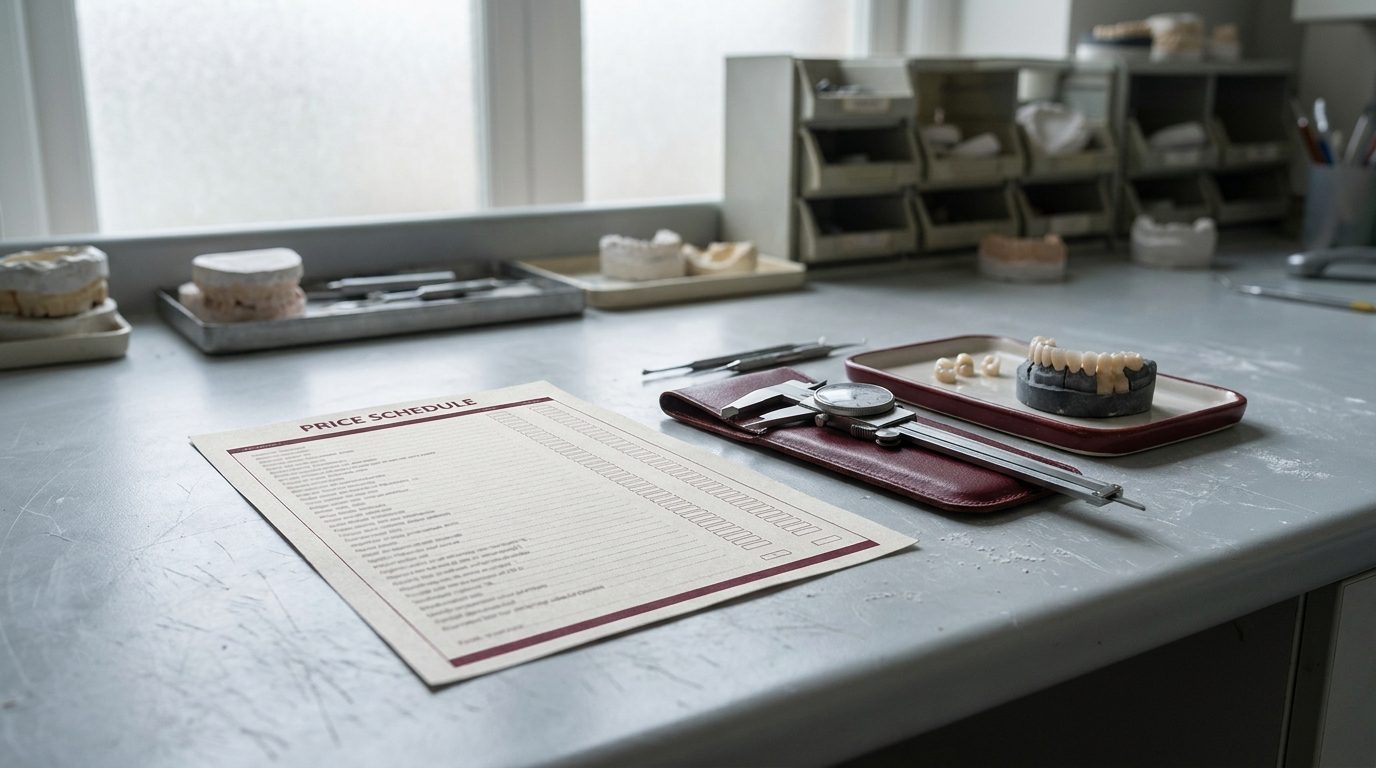
- True cost per case includes direct materials, loaded labor at 1.3–1.5 times base wage, machine depreciation, allocated overhead and a 2–5% remake reserve.
- Target gross margin should range from 50% for commodity cases to 65% for complex esthetic or implant cases, per NADL 2023 benchmarking data.
- A posterior monolithic zirconia crown with $35 total cost and a 60% target margin requires a list price of $88 to sustain operations.
- Review and adjust the lab price list every 12 months at minimum, and immediately when material costs change by more than 10%.
- Volume discounts are defensible at 5–15% off list price when a high-volume doctor reduces per-case overhead and administrative cost.
- Labs using cost-tracking software report 12–18% higher gross margins than those relying on spreadsheets, according to NADL survey data.
A defensible dental lab price list starts with accurate cost per unit—direct materials, labor, equipment time and allocated overhead—then applies margin targets by case complexity. Most labs under-price by 15–30% because they ignore machine time, QC labor and remake reserves, according to the National Association of Dental Laboratories' 2023 benchmarking survey. Dental lab pricing must cover every dollar spent to produce and deliver a case, plus margin sufficient to fund growth, equipment replacement and working capital.
Cost per case is the sum of direct material cost, direct technician labor at loaded hourly rate, allocated machine time, allocated overhead and a reserve for remakes and adjustments. Only after knowing true cost can a lab owner set a price per unit crown, bridge or denture that sustains the business.
What costs must a dental lab include in price per unit?
Every price per unit must recover five cost categories: direct materials (zirconia blank, Ti-base, stain, glaze), direct labor (the technician's loaded hourly wage times minutes on task), machine time (mill depreciation, bur wear, sintering-furnace cycle cost), allocated overhead (rent, utilities, software licenses, administrative salaries) and a remake reserve (typically 2–5% of revenue to cover no-charge remakes). A single-unit monolithic zirconia crown that costs $8 in material, $12 in labor at $60/hour loaded rate for 12 minutes, $3 in machine time and $7 in allocated overhead carries a total cost of $30 before any margin.
Direct material cost is the invoice price of the blank, abutment or resin divided by units yielded. A $45 zirconia puck milled into five crowns costs $9 per crown in material. Direct labor is technician time multiplied by the loaded hourly rate—base wage plus payroll taxes, benefits and paid time off, typically 1.3–1.5 times base wage. Machine time includes depreciation per hour, maintenance contracts and consumables: a $120,000 five-axis mill depreciated over five years at 2,000 hours per year costs $12 per machine-hour, plus burs at roughly $2 per unit milled.
Allocated overhead is total monthly indirect expense—rent, utilities, management salaries, software subscriptions, insurance—divided by units shipped. A lab shipping 400 units per month with $20,000 in overhead allocates $50 per unit. Smaller labs carry higher per-unit overhead; higher volume spreads fixed costs. The remake reserve is historical remake rate times average cost per remake: a lab with a 3% remake rate and $40 average remake cost should reserve $1.20 per unit shipped.
How should a lab calculate loaded hourly labor rate?
Loaded hourly labor rate is the technician's annual total compensation—base salary, payroll taxes (FICA, unemployment), health insurance, retirement contributions and paid time off—divided by annual billable hours. A technician earning $50,000 base with $7,650 in payroll taxes, $6,000 in benefits and two weeks paid vacation works 2,000 hours per year but delivers roughly 1,800 billable hours after breaks, training and non-production time. Total compensation of $63,650 divided by 1,800 billable hours yields a loaded rate of $35.36 per hour.
Most labs under-calculate this rate by using base wage alone, which omits 25–35% of true labor cost. Track actual minutes per case type over 30 days to establish realistic time standards: a posterior monolithic zirconia crown averages 18–22 minutes from design through final polish in most labs, per Inside Dental Technology's 2022 workflow study. Multiply that time by the loaded rate to find labor cost per unit. A 20-minute crown at $35/hour costs $11.67 in labor.
What margin should a dental lab apply to cost per case?
Target gross margin—revenue minus direct costs, expressed as a percentage of revenue—should range from 50% to 65% for most restorative case types, according to NADL benchmarking data (2023). A case with $30 in total cost and a 60% target margin requires a price of $75 ($30 / 0.40, since cost is 40% of price when margin is 60%). Higher-complexity cases (full-arch, implant bars, layered anterior veneers) justify 65–70% margin because they carry higher skill requirements, longer cycle times and greater remake risk.
Commodity cases—single posterior crowns, nightguards, clear retainers—operate at 50–55% margin in competitive markets. Margin below 50% leaves insufficient funds for equipment replacement, working capital and owner profit after operating expenses. Calculate breakeven volume monthly: total fixed costs divided by average contribution margin per unit (price minus variable cost). A lab with $25,000 in monthly fixed costs and $40 average contribution per unit must ship 625 units to break even.
How should a lab structure a price list by case type?
Structure the lab price list in tiers by material, case complexity and tooth position. Group cases into single-unit crowns (anterior vs. posterior, by material), multi-unit bridges (per pontic and retainer), implant restorations (screw-retained vs. cement-retained, stock vs. custom abutment), removable prosthetics (partial frameworks, complete dentures, flexible partials) and appliances (nightguards, retainers, splints). Within each category, list the base price and any upcharges for rush service, premium esthetics or difficult-shade cases.
A typical structure: posterior monolithic zirconia crown $95, anterior layered zirconia crown $145, three-unit zirconia bridge $285 (calculated as two retainers at full price plus one pontic at 70% of crown price), IPS e.max anterior veneer $165, screw-retained implant crown on Ti-base $195, cement-retained implant crown $175, custom zirconia abutment $125, full-arch zirconia bridge $2,400, cast partial framework $385, complete denture $495. Rush fees (case delivered in half standard TAT) add 30–50% to base price.
| Case type | Material cost | Labor + machine | Overhead allocation | Total cost | Target margin | List price |
|---|---|---|---|---|---|---|
| Posterior monolithic zirconia crown | $9 | $18 | $8 | $35 | 60% | $88 |
| Anterior layered zirconia crown | $12 | $38 | $10 | $60 | 65% | $171 |
| IPS e.max veneer | $18 | $42 | $10 | $70 | 65% | $200 |
| 3-unit zirconia bridge | $22 | $52 | $18 | $92 | 60% | $230 |
| Implant crown on Ti-base | $28 | $35 | $12 | $75 | 62% | $197 |
| Complete denture | $45 | $95 | $25 | $165 | 58% | $393 |
How often should a lab update its price list?
Review and adjust the lab price list every 12 months at minimum, and immediately when material costs change by more than 10% or when a major equipment purchase changes depreciation burden. Zirconia blank prices rose 8–12% in 2022–2023 due to supply-chain disruptions, per Ivoclar and Kuraray Noritake distributor reports. A lab that does not pass through material increases within 60–90 days loses margin permanently. Communicate price changes to doctors 60 days in advance with a one-page explanation of cost drivers—material increases, wage adjustments, new equipment investments.
Track actual cost per case monthly in your practice-management or lab-management software. Compare invoiced price to calculated cost for each case type and flag any where margin falls below target. If posterior zirconia crowns consistently run $38 in cost but are priced at $85 (55% margin instead of the 60% target), either reduce cost through process improvement or raise the price to $95. Annual price adjustments of 3–5% keep pace with general inflation and wage growth without shocking doctor customers.
Should a lab offer volume discounts or doctor-specific pricing?
Volume discounts are defensible when a high-volume doctor reduces per-case overhead allocation and administrative cost—fewer invoices, predictable weekly volume, faster case acceptance. Offer tiered discounts: 5% off list price for doctors sending 20+ units per month, 10% off for 50+ units per month, 15% off for 100+ units per month. Calculate the discount threshold by determining the overhead savings: a doctor sending 50 units per month in predictable batches may save the lab $3–5 per unit in administrative and logistics cost, justifying a 10% discount on a $100 average case.
Doctor-specific pricing—custom rates negotiated case by case—creates administrative burden, makes cost accounting impossible and invites price erosion. Set a published price list, apply transparent volume tiers and hold the line. When a doctor requests a deeper discount, respond with the cost breakdown and the margin required to sustain quality and delivery performance. Most doctors respect a lab that can explain its pricing in operational terms rather than one that discounts arbitrarily to retain the account.
What are the most common pricing mistakes dental labs make?
The most common pricing mistakes are underestimating labor time, ignoring machine depreciation, failing to allocate overhead and setting prices by competitor survey rather than cost. A lab that prices a zirconia crown at $75 because "that's the market rate" without knowing its own $82 cost loses $7 per unit and cannot sustain operations. Other frequent errors: not reserving for remakes (a 4% remake rate on $90 average cost is $3.60 per unit that must be priced in), using unloaded wage rates instead of fully-loaded rates and applying the same margin to all case types regardless of complexity or risk.
Failing to update prices when costs rise is a slow path to insolvency. A lab that holds prices flat for three years while wages rise 4% annually and material costs rise 10% cumulatively has lost 15–20% of its margin. Track cost per case monthly, compare to price and adjust when margin falls outside target range. Transparency with doctor customers—"Our zirconia blank cost increased $4 per crown in Q2; we are passing through $3 of that increase effective August 1"—builds trust and prevents price-shock attrition.
How can lab management software improve pricing accuracy?
Lab management software (LabSync, LabStar, Dentrix Ascend Lab) automates cost tracking by case type, captures actual technician time per case and allocates overhead in real time. These platforms pull material cost from inventory records, log labor minutes from technician check-ins at each workflow stage and apply overhead allocation rules set by the lab owner. Monthly cost reports show actual cost per case type versus budgeted cost and flag cases where margin falls below target, according to LabSync's 2023 user data.
Automated pricing tools within lab software allow the owner to set margin targets by category and generate a price list that updates when input costs change. When a zirconia blank price rises from $42 to $48, the system recalculates cost per crown and suggests a new list price to maintain target margin. Integration with practice-management systems ensures that every case invoiced is priced according to the current list, eliminating manual lookup errors and underbilling. Labs using cost-tracking software report 12–18% higher gross margins than those relying on spreadsheets, per NADL survey data (2023).
Build a defensible lab price list by calculating true cost per case—materials, loaded labor, machine time, overhead and remake reserve—then applying margin targets of 50–65% by case complexity. Review costs and prices every 12 months, pass through material increases within 60–90 days and offer volume discounts only when they reflect real overhead savings. A lab that knows its cost per unit and prices accordingly will outlast competitors who guess.
Sources
- NADL Industry Benchmarking Survey 2023 National Association of Dental Laboratories
- Workflow Efficiency Study 2022 Inside Dental Technology
- IPS e.max CAD Technical Data Ivoclar
- Dental Ceramics Material Data Kuraray Noritake Dental
Frequently asked questions
What is a realistic gross margin target for a dental lab?
A realistic gross margin target is 50–65% of revenue, with 50–55% for commodity single crowns and nightguards, 60% for standard multi-unit cases and 65–70% for complex esthetic or full-arch restorations. Margin below 50% leaves insufficient funds for equipment replacement and owner profit after operating expenses.
How do I calculate loaded hourly labor rate for a dental technician?
Loaded hourly labor rate is total annual compensation—base salary, payroll taxes, benefits and paid time off—divided by annual billable hours. A technician earning $50,000 base with $13,650 in taxes and benefits, working 1,800 billable hours per year, has a loaded rate of $35.36 per hour.
Should I match competitor prices or price by my own cost?
Always price by your own cost plus target margin, not by competitor survey. A lab that prices a crown at $75 because competitors do, without knowing its own $82 cost, loses $7 per unit and cannot sustain quality or delivery performance over time.
How much should I charge for a rush case?
Rush fees for cases delivered in half the standard turnaround time should add 30–50% to the base price, reflecting overtime labor, disrupted workflow and opportunity cost. A $95 standard crown becomes $125–$143 as a rush case.
What percentage of revenue should I reserve for remakes?
Reserve 2–5% of revenue for no-charge remakes and adjustments, based on your historical remake rate. A lab with a 3% remake rate and $40 average remake cost should reserve $1.20 per unit shipped to cover remake expenses without eroding margin.